Commercial roofing for self-storage facilities, mini-storage buildings, and climate-controlled storage properties throughout Indianapolis, IN.
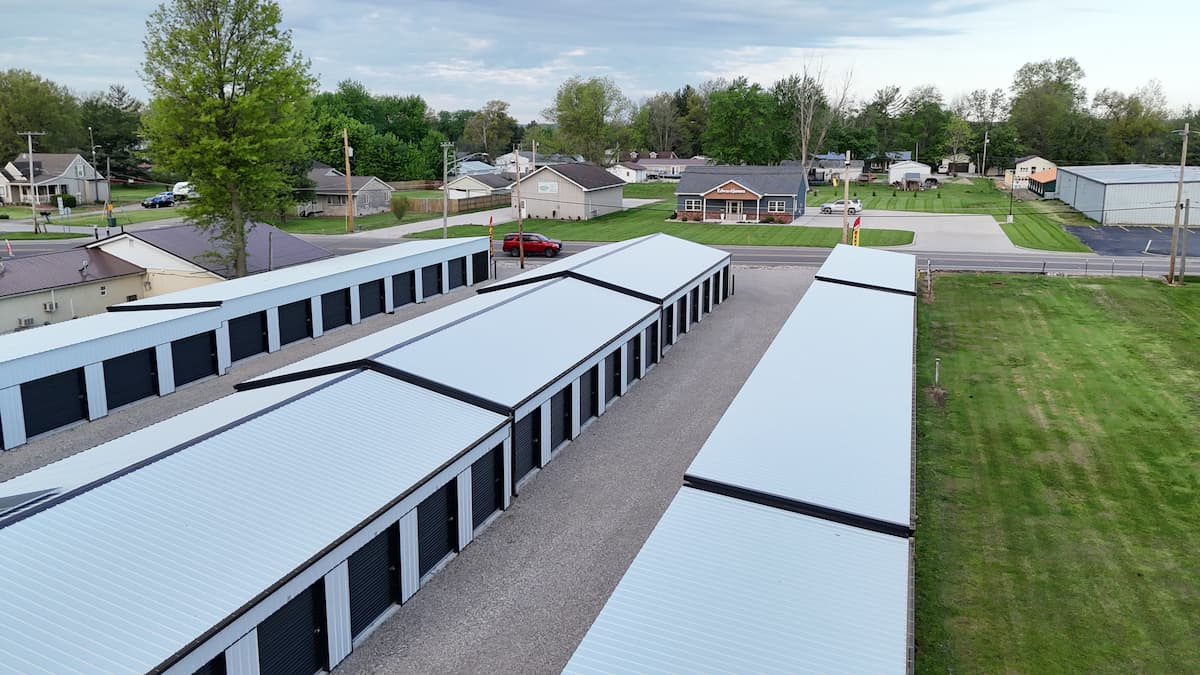
Self-storage facilities in Indianapolis present a specific set of roofing conditions that differ from other commercial property types: long, uninterrupted roof spans over individual unit rows, large aggregate roof areas spread across multiple structures, metal panel systems on older facilities, and tenants whose stored belongings create direct liability exposure if a leak goes undetected. Commercial Roofers Indianapolis works with self-storage operators and property management companies across Marion County and Central Indiana to inspect, repair, and replace roofing systems on all facility types — from single-story drive-up rows to multi-story climate-controlled buildings.
Older Indianapolis self-storage facilities built in the 1980s and 1990s typically have standing seam or R-panel metal roofing on individual unit rows. Newer climate-controlled buildings are more commonly built with TPO or EPDM flat roofing. Each system type has different failure modes and maintenance requirements. Metal roofs develop rust at fastener penetrations, panel laps, and ridge caps. Flat membrane roofs on storage buildings are subject to the same ponding and freeze-thaw degradation as any other Indianapolis commercial flat roof, with the added challenge that roof access points are often minimal and interior water intrusion may go unnoticed for extended periods before a tenant reports damage.
A roof leak on a self-storage row in Indianapolis creates immediate liability risk when tenant property is damaged. Proactive leak detection — through annual membrane inspections, drain audits, and infrared moisture surveys — is far less expensive than responding to tenant claims. Documented inspection reports also provide the facility operator with a defensible record showing that reasonable maintenance was performed, which is relevant to insurance claim processing and tenant dispute resolution.
Central Indiana winters create ice dam conditions at the eaves of metal storage unit roofs, and freeze-thaw cycling opens panel lap seams and cracks caulk at wall transitions. Summer UV exposure accelerates coating degradation on painted metal panels, and heavy spring rain events test drain capacity on flat-roof climate-controlled buildings. Self-storage facilities in the I-465 corridor are also exposed to Midwest hailstorms that can dent and fracture metal panel roofs, creating leak pathways at the impact points.
Standing seam and R-panel metal roofs on Indianapolis storage unit rows can often be restored rather than replaced. Fluid-applied silicone or acrylic coatings applied over clean, prepared metal extend service life by sealing panel laps, covering fastener heads, and providing a reflective UV-resistant barrier. For roofs with significant rust or panel damage, targeted panel replacement combined with a coating system is frequently the most cost-effective path. Full tear-off and replacement is warranted when corrosion has compromised the structural integrity of the panels or when the underlying purlins show deterioration.
Multi-story climate-controlled storage buildings in Indianapolis typically use TPO or EPDM flat roofing systems. When these systems reach end of life, tear-off and replacement with a new TPO or PVC system is standard. Tapered insulation is often added during replacement to correct ponding conditions caused by roof settlement or inadequate original slope. The replacement process for occupied storage buildings requires careful sequencing to keep the building interior protected at all times — no open decks overnight, no drain interruptions during heavy rain periods.
Tell us about the building and the roof problem. We'll document it and put a plan in writing — with an honest repair-vs-replace recommendation and no upsell pressure.
Get a Roof Assessment →