Multi-year roof CapEx forecasting for Indianapolis commercial portfolios — sequencing replacement across buildings, supporting the capital ask to ownership and lenders, and accounting for Indiana's freeze-thaw acceleration.
For Indianapolis commercial building owners and property managers who need to justify a roof capital request to a board, lender, or ownership group, a verbal estimate and a verbal condition description are not enough. Capital Planning Support from Commercial Roofers Indianapolis delivers multi-year CapEx forecasting anchored to documented condition data — membrane age, moisture findings, flashing condition, and deck integrity — across a single building or an entire portfolio of Central Indiana properties. The result is a written capital plan that supports a budget request, a board presentation, or a 5-to-10-year reserve study with defensible numbers.
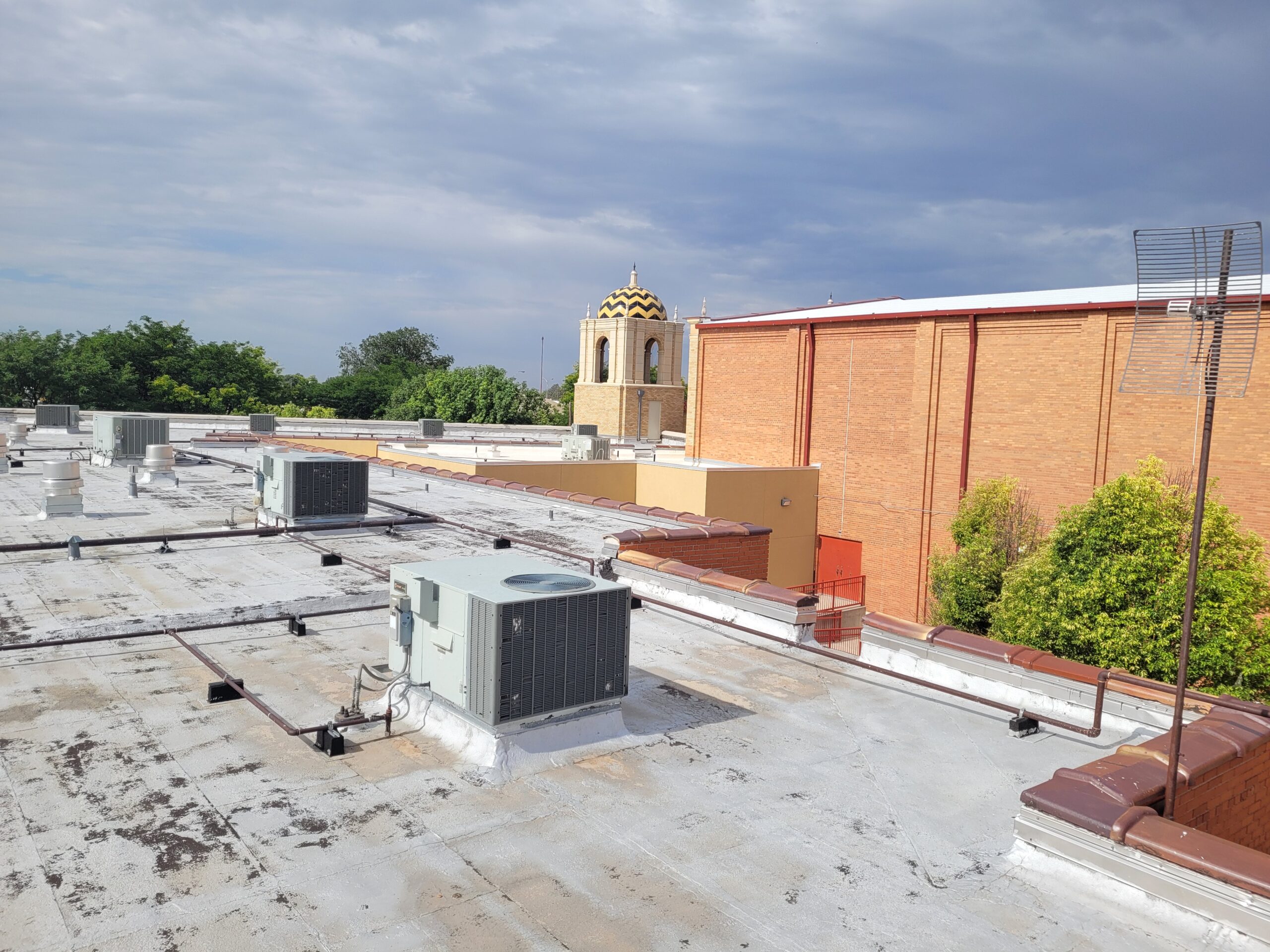
A capital planning engagement begins with a physical condition assessment of each roof in scope. We document membrane type, installation year (confirmed from warranty records or core samples when the records don't exist), surface condition, flashing integrity, drain function, and any evidence of subsurface moisture through core sampling or infrared scanning. Each roof section receives a condition rating — serviceable, watch, action-required — with an estimated remaining service life range. Those findings feed a multi-year capital model that sequences replacement and major maintenance expenditures across the planning horizon, weighted by building priority, roof criticality, and available capital in each budget year.
Commercial property portfolios along the I-465 corridor and in Indianapolis's suburban office parks often include buildings constructed in multiple decades with mixed roofing systems — some with 1980s BUR, some with early-generation TPO from the 1990s, and some with newer single-ply that still carries manufacturer warranty coverage. Rationalizing that mixed inventory requires condition data, not assumptions. A roof that looks fine from the ground may have significant wet insulation requiring near-term replacement. A roof assumed to be end-of-life may have a dry, sound assembly that warrants a coating extension rather than full tear-off. Capital plans built on assumptions rather than data consistently result in either over-spending or deferred emergencies, both of which cost more than a systematic assessment would have.
We build Indianapolis-specific assumptions into every capital model. Central Indiana's freeze-thaw cycle, summer heat loading, and annual average hail frequency all affect how quickly a roof moves from serviceable to action-required. A TPO system installed in Indianapolis without regular drain maintenance ages faster than manufacturer data suggests because Marion County's storm events regularly overwhelm flat-roof drainage during heavy rain, and ponding accelerates seam stress. We adjust remaining-life projections for documented maintenance history — or the absence of it — and note the adjustment in writing so the capital plan reflects actual conditions rather than theoretical averages.
Board and ownership presentations for roof capital typically need three things: a clear statement of the problem, documentation that the scope is right-sized (neither inflated nor deferred), and evidence that the contractor recommendation is credible. Our capital planning deliverables address all three. The written condition report provides photo-keyed documentation of the problems. The recover-vs.-replace analysis demonstrates that the recommended scope is cost-justified. The multi-year model shows how deferring year-one expenditures escalates total cost over the planning horizon. We can present these findings directly to ownership groups, lenders, or property management boards on request.
For Indianapolis property managers handling five, ten, or more commercial buildings, capital sequencing is as important as individual building assessments. Replacing every roof that qualifies for replacement in the same year is rarely feasible. We prioritize buildings by roof criticality — a roof over occupied tenant space ranks above a storage annex — and by the cost differential between replacement now and replacement after one more year of deterioration. Roofs with confirmed wet insulation are flagged as immediate, since wet insulation under a membrane accelerates deck deterioration in a way that increases total replacement cost rapidly. Roofs with dry assemblies and minor flashing issues may be extended with targeted maintenance. The capital model sequences all of these recommendations across your planning horizon with year-by-year expenditure projections.
Every capital planning engagement closes with a written condition report for each roof in scope, a multi-year capital model in spreadsheet format with configurable inflation and escalation assumptions, and a prioritized action list with recommended project year for each building. For portfolio owners preparing reserve studies or lender submissions, we provide a consolidated executive summary suitable for direct inclusion in the capital package. All condition photography is date-stamped and keyed to a roof plan diagram for each building.
Tell us about the building and the roof problem. We'll document it and put a plan in writing — with an honest repair-vs-replace recommendation and no upsell pressure.
Get a Roof Assessment →