Commercial Re-Roofing for commercial buildings across Indianapolis.
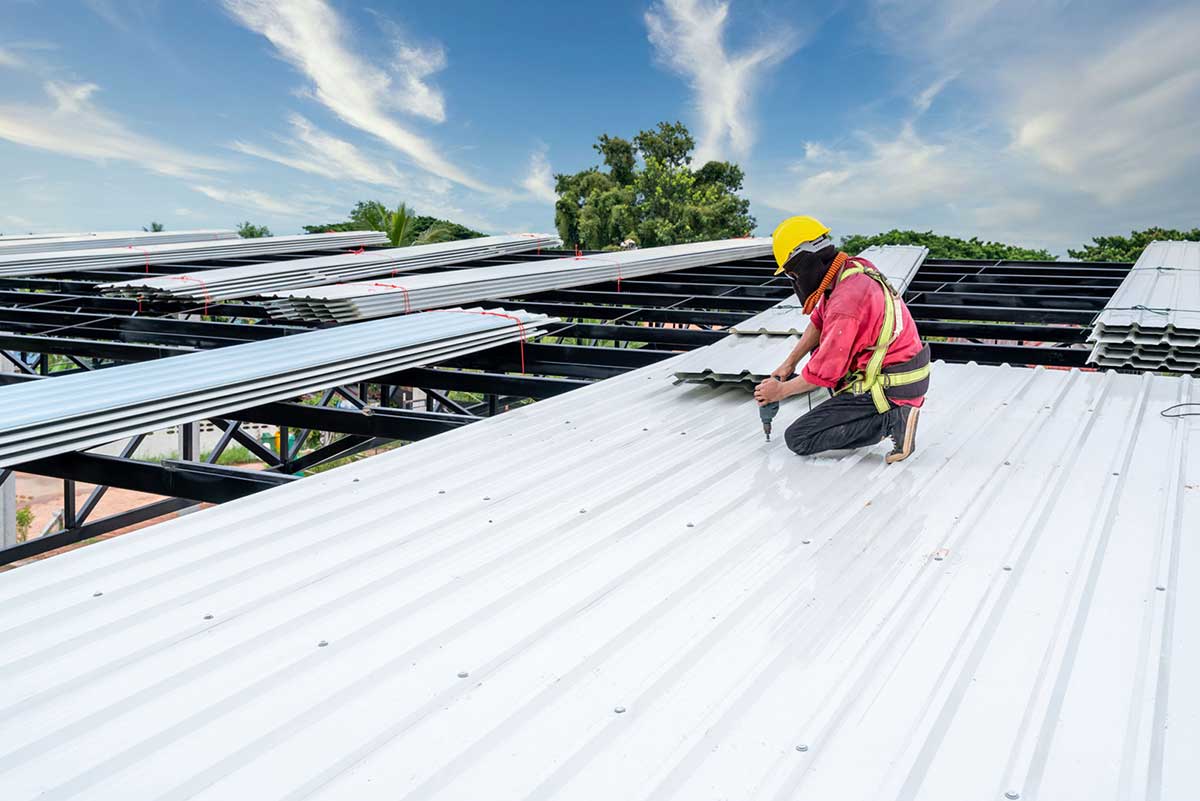
When your commercial roof has reached the end of its serviceable life, a full re-roofing project replaces the existing system down to the deck and installs a new, code-compliant membrane designed to last 20 to 30 years. Indianapolis property owners across Marion County choose commercial re-roofing when repeated repairs no longer make economic sense, when moisture saturation is widespread, or when the current system no longer meets energy-code requirements. A properly executed re-roof eliminates latent leak paths, restores the building envelope, and gives you a clean warranty baseline.
Re-roofing is a complete tear-off and replacement — not a patch or a recover. Every layer of the old system is removed, exposing the roof deck. The deck is then inspected for rot, delamination, or fastener pull-out; damaged sections are replaced before anything is laid on top. A new vapor retarder, insulation board, and membrane are installed from scratch. The result is a system whose performance is fully predictable and fully warranted.
Unlike a recover or overlay, re-roofing eliminates all trapped moisture from the previous system. This is critical in Indianapolis, where freeze-thaw cycles between October and March can expand existing moisture pockets and cause catastrophic delamination of insulation layers.
Central Indiana's climate puts commercial roofs under stress from multiple directions. Summers bring intense UV radiation and prolonged heat that degrades membrane plasticizers and lap seams. Winters deliver snow loads, ice damming at parapets and drains, and freeze-thaw cycling that opens micro-cracks into major leak paths. Spring and fall bring severe Midwest storms with hail and wind-driven rain. When a roof has absorbed enough cycles of thermal shock, no maintenance program restores its integrity — replacement is the only durable answer.
Ponding water is another Indianapolis-specific concern. Flat and low-slope commercial roofs here often develop inadequate drainage over time as decks deflect and drains partially clog with leaf debris and sediment. Ponding accelerates membrane degradation and creates the conditions that make re-roofing necessary years earlier than expected on a well-drained roof.
The two most common membrane types installed during Indianapolis commercial re-roofing projects are TPO (thermoplastic polyolefin) and EPDM (ethylene propylene diene monomer). TPO heat-welded seams perform well under the thermal cycling common in Central Indiana, while EPDM offers long-term UV resistance and excellent cold-weather flexibility. For facilities requiring enhanced puncture resistance — distribution centers, manufacturing plants, or roofs with heavy foot traffic — PVC membranes are also specified. Insulation is typically polyisocyanurate board, sized to meet current ASHRAE 90.1 minimums for the Indianapolis climate zone.
A commercial re-roofing project begins with a thorough assessment: infrared or nuclear moisture scanning to quantify wet insulation, core cuts to identify existing system layers, and a structural review of deck attachment. From that data, a written scope of work is produced that itemizes tear-off layers, deck repair allowances, new system specification, and warranty parameters. Only after the owner approves the written scope does work begin.
During tear-off, debris is contained and removed continuously to avoid overloading the deck or creating trip hazards. New insulation is mechanically fastened or adhered to the deck according to the wind-uplift requirements for the Indianapolis zone. The membrane is then installed, seams are inspected and tested, and all penetrations, drains, curbs, and edge metal are integrated and sealed. A final inspection — typically including a water test on critical laps — closes out the project before warranty documents are issued.
If repair invoices over three years exceed 30 percent of replacement cost, if moisture scanning shows more than 25 percent of insulation saturated, or if the existing membrane is older than its rated life expectancy, re-roofing is almost always the lower total-cost path. Continued patching on a failing system consumes budget without arresting deterioration, and each winter cycle risks interior damage to inventory, equipment, or tenant improvements that dwarfs the cost of replacement.
Upon project completion you receive a written warranty covering both workmanship and manufacturer materials, a marked-up roof plan documenting all penetrations and drain locations, core-cut and moisture-scan documentation from pre-construction, and photo records of deck condition at tear-off. These documents support insurance renewals, due-diligence requests during property transactions, and future maintenance planning.
Tell us about the building and the roof problem. We'll document it and put a plan in writing — with an honest repair-vs-replace recommendation and no upsell pressure.
Get a Roof Assessment →