Recover-vs-replace decision framework, moisture core sampling, and recover system design for Indianapolis commercial flat roofs — honest guidance on when recovery saves capital and when it doesn't.
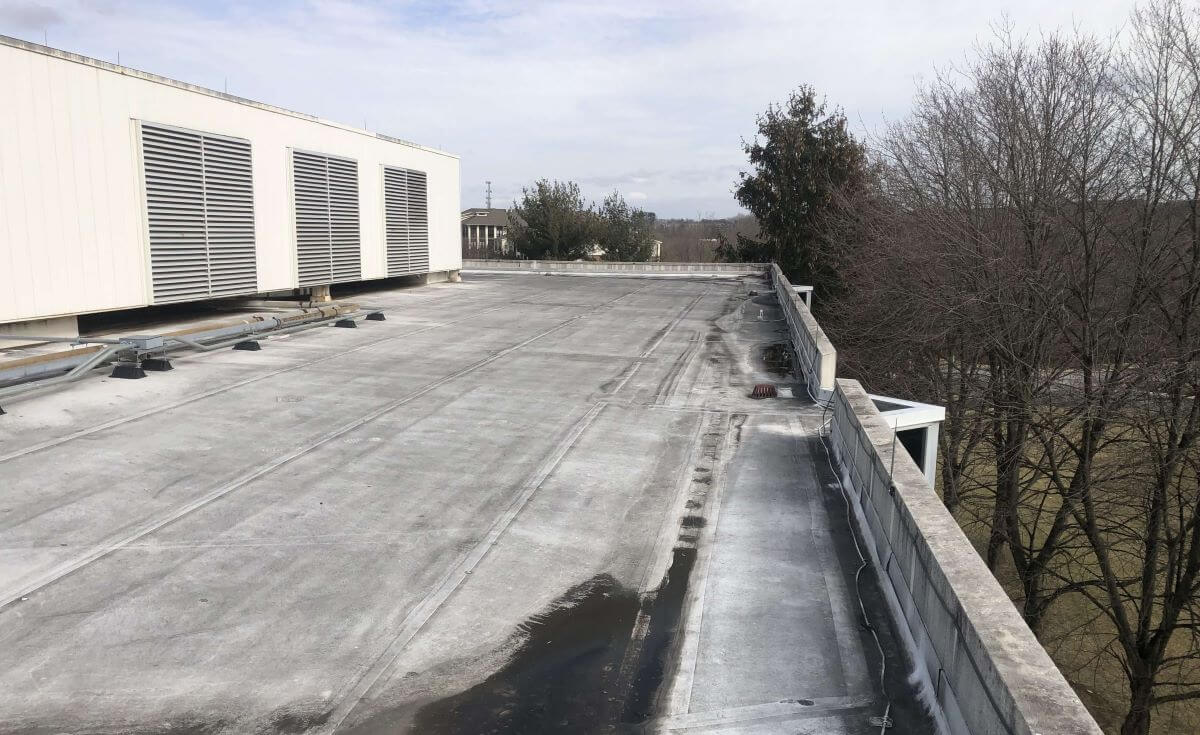
Roof recover systems are engineered assemblies designed to extend the life of an existing commercial roof by installing new waterproofing layers over the in-place system without a full tear-off. Selecting the right recover system for an Indianapolis commercial building requires evaluating the existing membrane type, insulation condition, deck structure, load capacity, and the climate stresses the roof will face. A recover system chosen for the wrong substrate or installed without adequate pre-project assessment will underperform and fail prematurely — the system selection process is as important as the installation itself.
The first question to answer before specifying any recover system is whether the existing roof qualifies for recover at all. Indianapolis building owners and their contractors should evaluate four variables: the number of existing roof layers (local code typically allows a maximum of two before tear-off is required), the extent of moisture saturation in the existing insulation (confirmed by infrared or nuclear scanning), the condition of the structural deck beneath, and the load-carrying capacity available to support the additional weight of a new system. A roof that fails any one of these criteria is a replacement candidate, not a recover candidate.
When all four variables are favorable, a recover system delivers a new warranted waterproofing layer at 40 to 60 percent of full replacement cost, with no exposure of the building interior to weather during construction.
No recover system specification should proceed without moisture core sampling. At minimum, one core cut per 10,000 square feet of roof area is taken at locations identified by infrared scanning as potentially wet. Each core documents the number of existing layers, insulation type and thickness, membrane attachment method, and moisture presence. Wet insulation areas identified through scanning and confirmed by cores are removed and replaced before the new system is installed over them — this is not optional. A recover system installed over wet insulation traps the moisture, accelerates corrosion of steel decking or delamination of wood decking, and creates odor and mold risk inside the building.
Several membrane systems are commonly specified for Indianapolis commercial roof recovers. Mechanically attached TPO is widely used because it eliminates solvent adhesives, accommodates substrate irregularities, and produces heat-welded seams with strong performance in the region's freeze-thaw cycling. Fully adhered EPDM over a cover board is specified where substrate smoothness is adequate and where a highly conformable membrane is needed around complex rooftop geometry. Fluid-applied coatings — silicone and acrylic formulations — represent a third category: these are sprayed or rolled onto an existing membrane and cure to a seamless monolithic layer, but they are coating systems, not true membrane recovers, and their performance depends heavily on the soundness of the substrate they are applied to.
In all cases, a cover board — typically half-inch to one-inch polyisocyanurate or high-density gypsum fiber board — is installed between the existing membrane and the new membrane to provide a uniform substrate, add insulation value, and eliminate fastener telegraph from the existing system.
Central Indiana's climate drives several system design decisions that differ from warmer or drier markets. Freeze-thaw cycling demands that all lap seams and flashings be installed with materials rated for low-temperature flexibility — several membrane types become brittle below 40°F and cannot be installed or heat-welded in cold conditions, which affects scheduling from November through March. Snow load design must account for the added weight of the recover system on roofs already carrying drifted snow loads at parapet walls and mechanical equipment screens. Summer UV intensity in Indianapolis argues for light-colored or reflective membrane surfaces that reduce rooftop temperatures and limit thermal shock cycling of lap seam welds.
The most critical detail work in any recover system is at the perimeter and penetrations. All existing edge metal, counter-flashings, and penetration boots must be evaluated individually — those that cannot be recovered over effectively are removed and replaced. New perimeter metal is typically installed over the new cover board before the new membrane is terminated and sealed to it. Penetration flashings — pipe boots, curb flashings, equipment supports — are all re-flashed with new materials compatible with the new membrane system. Attempting to recover over deteriorated base flashings is the single most common source of early failure in a recover installation.
Manufacturer warranties on recover systems are structured similarly to full-replacement warranties — 10 to 20 years depending on membrane thickness and specification — but apply only to the new membrane and new components. Pre-existing wet insulation areas that were excised and replaced carry the new warranty; adjacent existing insulation that was not replaced does not. Post-project documentation includes the moisture scan maps, core-cut records, wet-area excision locations on the roof plan, and final inspection photographs. These records support warranty claims and provide a baseline for future maintenance program documentation.
Tell us about the building and the roof problem. We'll document it and put a plan in writing — with an honest repair-vs-replace recommendation and no upsell pressure.
Get a Roof Assessment →