Commercial flat roof leak repair across Indianapolis and Marion County — root-cause inspection, written scope, fixed-price repair, no replacement upsell on roofs with serviceable remaining life.
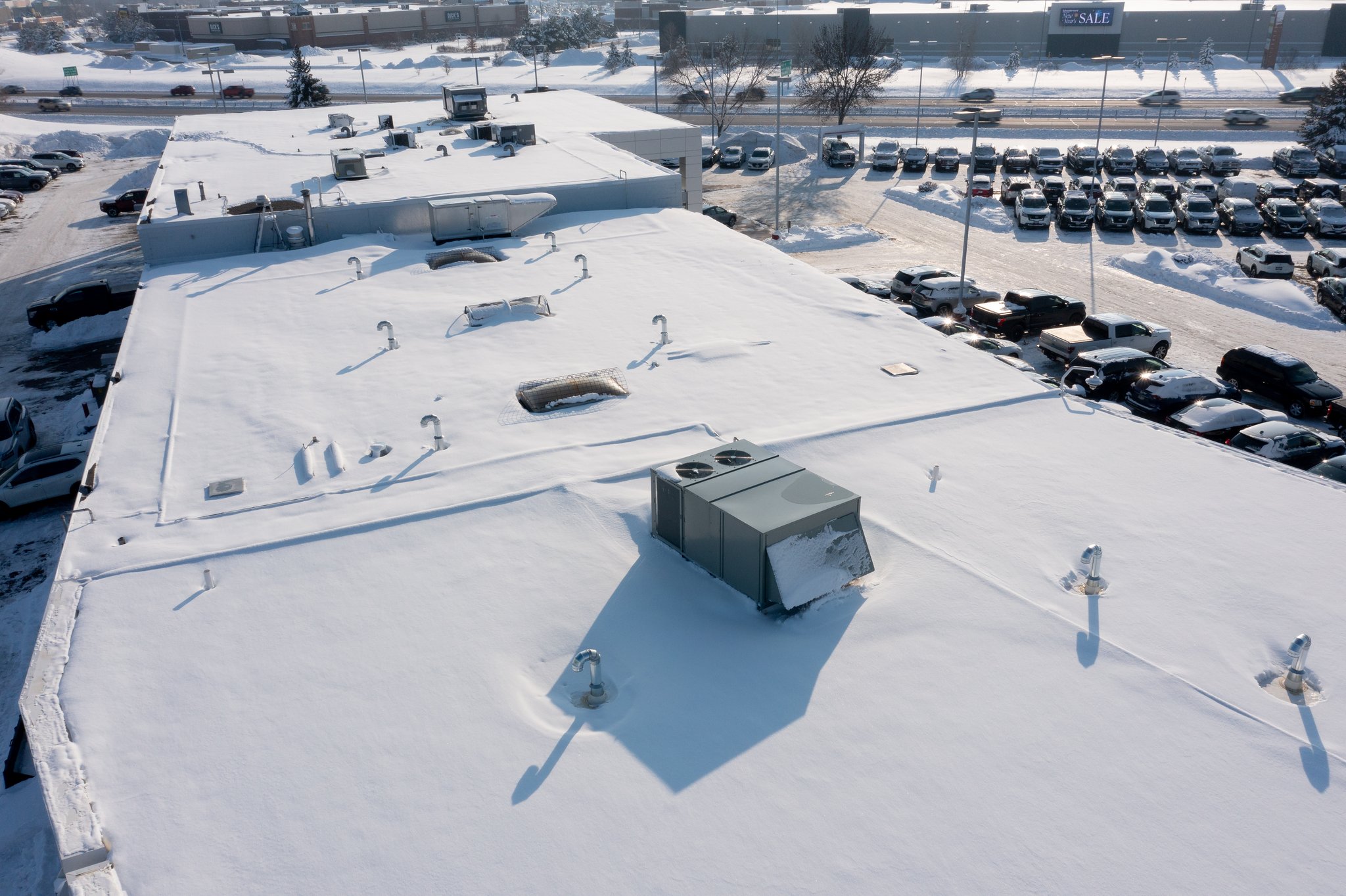
Commercial flat roof leaks in Indianapolis follow a predictable pattern: they appear at the worst possible time — during a spring storm, mid-week, with tenants, merchandise, or equipment below — and the source is rarely where the interior water stain appears. Water on a flat roof travels horizontally under the membrane before finding an exit point, which means the visible interior damage may be feet or yards away from the actual membrane breach. Effective commercial roof leak repair in Marion County requires a systematic diagnosis process that finds the true source, not just patches the nearest visible damage.
Leak diagnosis on Indianapolis commercial flat roofs begins with a structured inspection that works from the interior out. Interior water stain location, stain pattern (drip point, running stain, diffuse seepage), and timing relative to rain events are the first data inputs. From the rooftop, the inspection prioritizes the statistically highest-failure locations for the identified roof system type: flashing at HVAC curbs and penetrations (most common on all system types), lap seam adhesion (common on aging mechanically attached TPO and EPDM), drain collar flashings (common on all systems with interior drains), pitch pan fill (common on buildings with older bituminous pitch pans), and parapet base flashing termination (common on older buildings with multiple prior repair layers). The goal is written documentation of the identified source before any repair work begins.
The majority of commercial flat roof leaks in Indianapolis trace to a handful of recurring failure modes. HVAC curb flashings fail as the membrane base flashing separates from the wall of the curb — a common failure mode on mechanically attached single-ply systems where the curb flash is under tension from the base sheet. Pipe penetration flashings fail when pitch pan fill shrinks and cracks or when pipe boot seals age. Drain collar flashings fail when the bonding adhesive between the membrane and the metal drain collar ages or when the drain body is disturbed by maintenance activity. Field seam separation occurs on aging mechanically attached TPO and EPDM systems, particularly at low points where ponding water accelerates adhesive degradation. Each failure mode requires a specific repair approach — not a generic caulk patch.
A significant portion of commercial roof leak calls in Indianapolis result in a contractor recommending full roof replacement when targeted repair would resolve the problem and extend useful system life by 5 to 10 years. This replacement-upsell pattern is frustrating and expensive for building owners who have a structurally sound system with isolated failures. Our approach: if the system has sound membrane in the majority of field area, sound core insulation (confirmed by core pull or infrared survey), and leaks that trace to defined, repairable sources, we will recommend and scope targeted repair. We only recommend replacement when condition data supports it — wet insulation above threshold, widespread seam failure, membrane brittleness that makes patch adhesion unreliable.
Central Indiana spring storm season — March through June — generates the highest volume of commercial roof leak emergencies in the Indianapolis market. Midwest severe weather events (heavy rain, hail, high wind) can create sudden large-area membrane failures that require immediate dry-in response to prevent interior damage. We provide same-day emergency response for commercial roof leak emergencies across Marion County and the surrounding metro. Emergency response includes tarping or membrane patching to stop active water entry, an interior damage assessment, and written documentation of storm-caused conditions — critical if an insurance claim will follow.
Every commercial roof leak repair we complete in Indianapolis is backed by written documentation: a pre-repair condition report identifying the source and failure mode, a written scope of work with materials specified by type and manufacturer, and a post-repair photo log confirming the completed work. This documentation serves multiple purposes: it gives the owner a record of what was repaired and what was observed, it supports warranty claims on in-warranty systems, and it provides baseline data for ongoing maintenance planning. We do not deliver verbal-only repair conclusions on commercial properties.
Every roof leak repair engagement delivers: a written root-cause diagnosis report with the identified source location, a written scope of work with materials specified, a fixed-price repair quote (no open-ended time-and-material billing on defined repairs), post-repair photo documentation, and a workmanship warranty in writing. If the inspection identifies additional conditions beyond the immediate leak source, these are documented separately with budget-range estimates — the owner decides what to address and when, without bundled upsells.
Tell us about the building and the roof problem. We'll document it and put a plan in writing — with an honest repair-vs-replace recommendation and no upsell pressure.
Get a Roof Assessment →