Solar-ready commercial roofing in Indianapolis, IN: PV racking penetrations, membrane compatibility, weight and uplift checks, and warranties coordinated between roofer and solar installer.
A solar developer sells you panels and production numbers, but rarely dwells on the fact that every panel has to live on your roof for two or three decades, and the roof is what keeps water out the whole time. We do the roofing side of solar across Indianapolis so the array lands on a deck that can carry it, every attachment stays watertight through freeze-thaw winters and muggy Julys, and the warranty paperwork between our crew and your solar contractor doesn't leave a gap that costs you. The buildings we are called to most are the low-slope warehouses along the I-70 and I-65 freight corridors, the office stock around Keystone at the Crossing and North Meridian, and the older flat-roofed plants in Park 100. Each takes an array differently, so we start at the roof, not the panel layout.
Commercial solar racking comes down to two approaches, and which one fits your building is a roofing question before it is an electrical one. Penetrating racks bolt straight through the membrane into the structure, giving a rock-solid connection, but every stanchion is a hole we then have to flash, weld or bond, and stand behind for the life of the roof. Ballasted racks skip the holes and hold the array down with weighted trays, trading penetrations for sheer dead load on your deck. On a healthy TPO or PVC membrane with plenty of life left, a cleanly flashed penetrating mount often beats dragging tons of concrete block across the field. On a roof that is already aging, we would rather not put a single new hole in it. We walk the roof and tell you which way the membrane and the structure actually point.
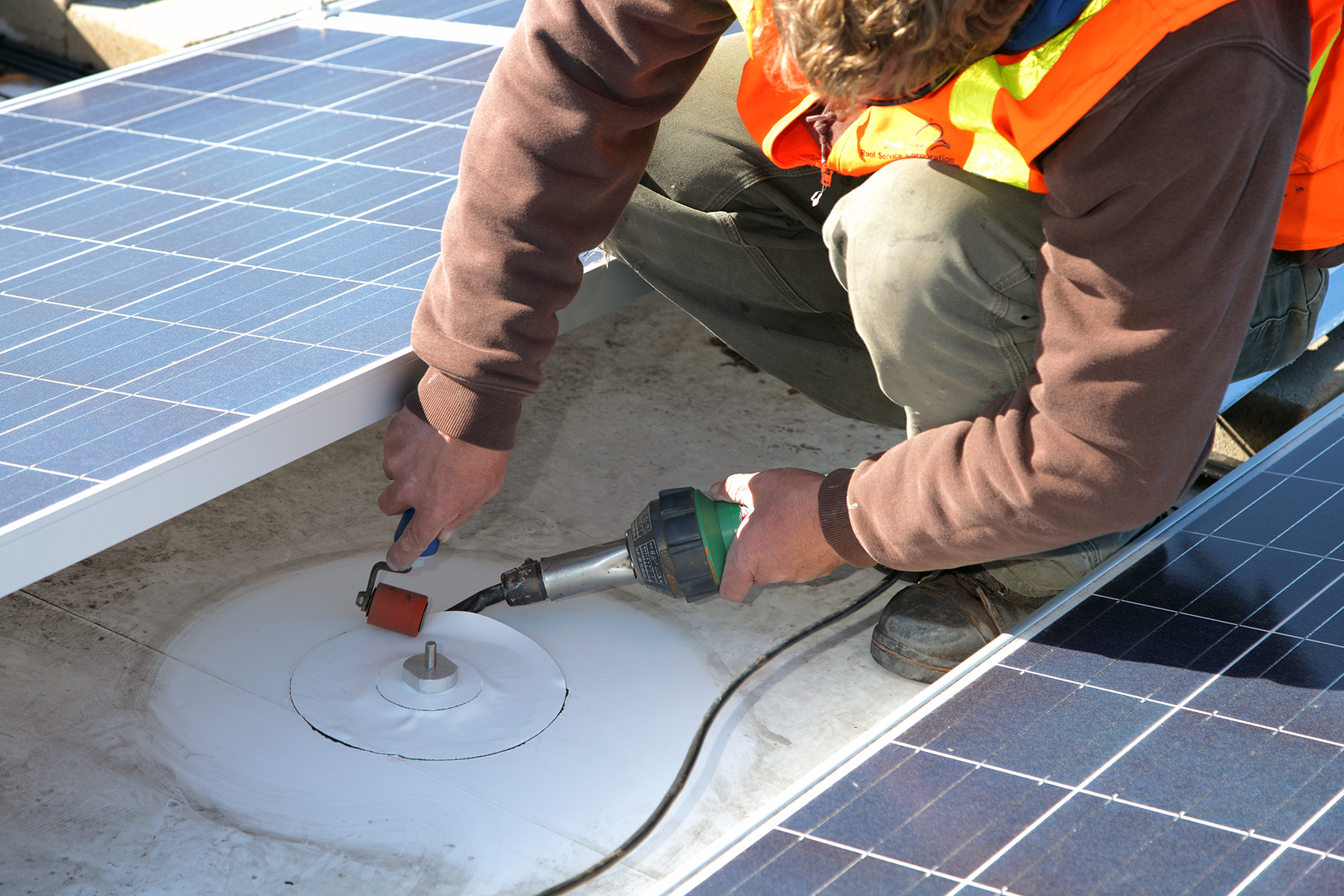
Whichever route we take, the detail at each post makes or breaks the job. We set penetrating stanchions on a curb or a manufacturer-approved boot, heat-welded into a thermoplastic field or chemically bonded into an EPDM field. We do not rely on a bead of sealant around the post, because sealant fails on its own schedule, and an array stitched together with caulk will leak long before it pays for itself. Every penetration gets treated like a brand-new pipe boot: real base flashing, a target patch fused down, and a profile that sheds water instead of ponding it.
Ballast is attractive because it avoids holes, but ballast is also load, and Indianapolis roofs were already engineered for a snow and drift allowance sized decades ago. Before anyone stages a pallet of block, the structure has to be checked for the combined weight of panels, racking, and ballast against what the deck and bar joists were built to hold. We have walked plenty of mid-century buildings around the near-east and southside industrial districts where the joists do not have the headroom, and the honest answer is a partial penetrating layout or structural reinforcement, not an array that quietly overloads the roof.
Uplift is the other side of the load problem. A field of panels behaves like a parking lot full of small wings, and central Indiana gets the straight-line wind events and spring severe-weather outbreaks that test edge securement. Ballast that pencils out for the middle of the roof is rarely enough at the perimeter and corners, where uplift pressures climb sharply. We map the ballast and any mechanical anchoring so the edge zones are held down, not just weighted, and the array cannot creep in a storm and abrade the membrane. If your perimeter and edge metal are already marginal, that is worth addressing before the panels go up, and it overlaps with how we handle built-up roofing and other systems where the edge condition drives everything.
Not every roof surface is a good partner for a solar mount. TPO and PVC are weldable thermoplastics, so we fabricate flashings that fuse into the field and become part of the membrane. EPDM is a cured rubber that takes a different bonded detail with the right primers and seam tapes. A gravel-surfaced built-up roof is a different animal entirely, and you generally do not want to ballast or penetrate one without dealing with the surface first. Part of our job is telling you plainly whether your membrane is a sound host for solar, or whether you would be smarter to recover or replace before committing to an array that would otherwise come back off in a few years. When that is the case, we lay out the roof recover options so the panels go onto a surface that will outlast them.
We also watch what the array does to the roof underneath. Shaded membrane runs cooler, which helps longevity, but the slot between panel and roof is where debris collects, where ponding hides, and where a leak is miserable to track down once everything is bolted in place. We plan walk paths, keep drains and scuppers out from under the layout, and make sure the array does not trap water against a low spot. A roof that drained fine bare can pond once you set a few hundred mounts on it. That hidden-moisture risk is why we pair solar work with a drone roof inspection before and after install, so a thermal baseline of the deck is on record.
The biggest single cause of solar roof failures we get called to has nothing to do with the panels. It is the seam between two contractors who each assumed the other owned the roof. The solar company is on the hook for the array and the electrical; the roofer is on the hook for keeping water out. When those scopes are never written down, every leak turns into a finger-pointing match and the owner is the one with a bucket on the floor. We head that off by putting the boundary in writing before anyone mobilizes: who flashes the penetrations, who holds the membrane warranty, who is liable if a module works loose, and who comes back when there is a leak after energizing.
Membrane manufacturers also have rules about who is allowed to touch their roof. Unapproved holes, or an outside crew detailing penetrations, can void the manufacturer warranty on the entire roof, not just the patch under the array. We coordinate with the manufacturer so the solar attachments are made by an authorized applicator and the warranty stays in force. If your roof still carries a no-dollar-limit warranty, that document is worth real money, and it is just the kind of thing that gets thrown away in the scramble to hit a tax-credit deadline.
Indianapolis sits in AES Indiana's service territory, and how your system interconnects shapes the whole project calendar. We are not your electrical contractor, but we have been on enough local jobs to know that interconnection review and permitting in Marion County can stretch a schedule, and the roofing work has to be sequenced around it. There is no sense heat-welding flashings in a January cold snap if the array cannot be energized until spring, so we plan the roof scope around the real timeline and never leave penetrations open through a hard freeze.
If you are re-roofing now and you already know solar is coming in a couple of years, the cheapest moment to get ready is before the new membrane goes down. We can specify a heavier or reinforced membrane in the future array zones, lay out where the penetrations will land, and document the structure so the eventual solar engineer is not guessing about your deck. Building it solar-ready up front costs far less than retrofitting flashings into a two-year-old roof and arguing about whose warranty covers the new holes. Whether you are adding panels to a Park 100 distribution building, an office near North Meridian, or a retail box off the I-465 ring, we will tell you honestly what your roof can carry, how we will keep it dry, and how to keep both warranties intact. Reach out and we will walk the roof with you before anyone draws a single panel. You can also read more about us and how we work across central Indiana.
Tell us about the building and the roof problem. We'll document it and put a plan in writing — with an honest repair-vs-replace recommendation and no upsell pressure.
Get a Roof Assessment →