Infrared thermography moisture surveys on Indianapolis commercial flat roofs — mapping wet insulation without destructive core pulls to support recover-vs-replace decisions and insurance documentation.
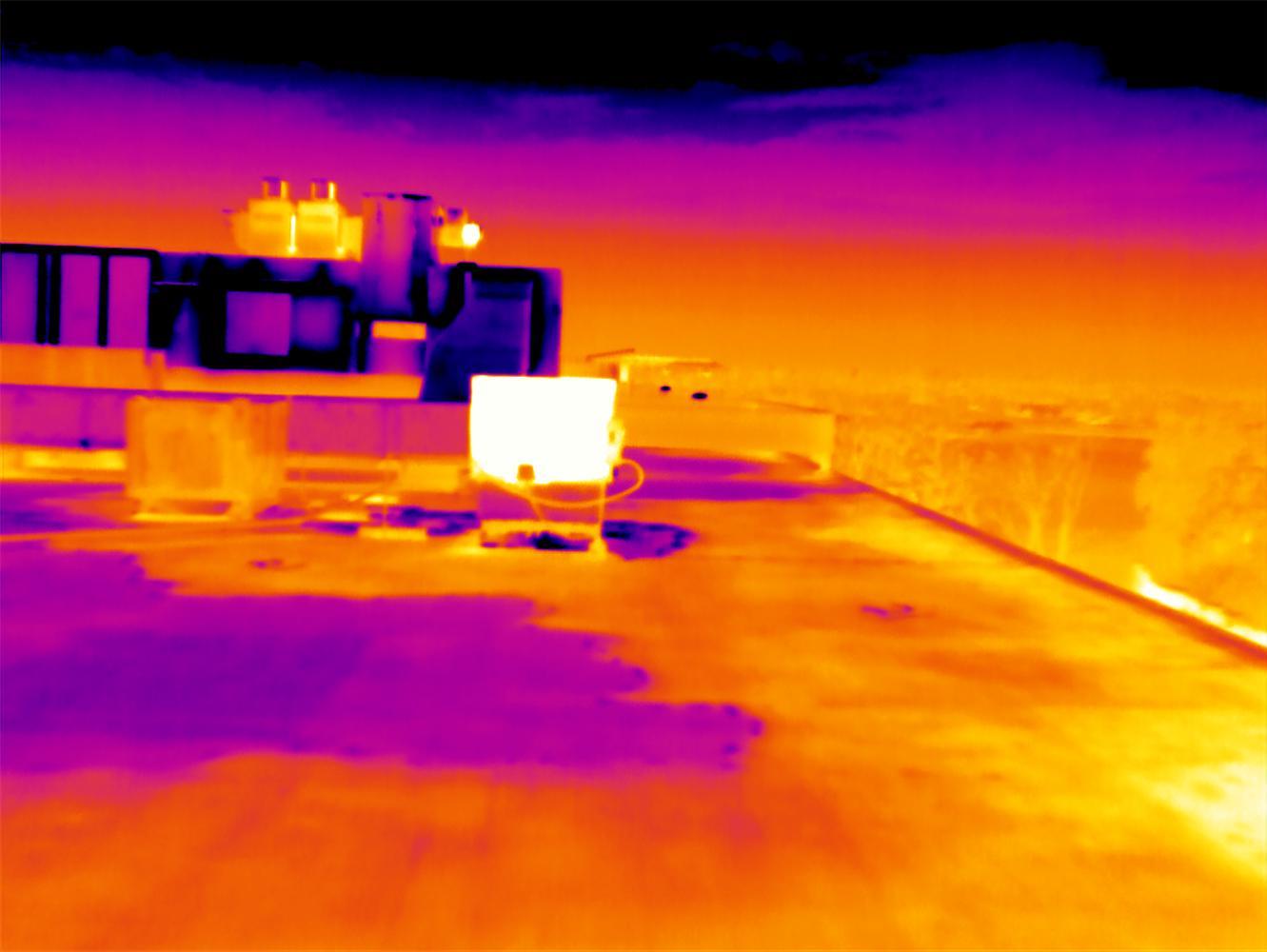
Infrared thermography moisture scanning is a non-destructive diagnostic tool used to map wet insulation in commercial flat roofs without cutting into the membrane. On Indianapolis commercial buildings — where flat roof assemblies can cover tens of thousands of square feet — knowing exactly where moisture has infiltrated the insulation before committing to a repair or replacement strategy is both financially and technically important. An infrared scan conducted under the right atmospheric conditions can identify wet zones across an entire roof surface in a single evening survey, producing a moisture map that guides targeted repair, recover system design, or replacement scoping with a precision that no visual inspection can match.
The physics behind infrared moisture scanning are straightforward: water-saturated insulation retains heat longer than dry insulation as the roof surface cools after sunset. An infrared camera captures the surface temperature differential — wet areas appear warmer than dry areas in the camera's thermal image during the 1–3 hour window after sunset when the differential is greatest. A qualified thermographer walks the roof with the camera, capturing sequential images that are then assembled into a composite moisture map of the entire roof area. Areas that show elevated surface temperature relative to their surroundings are flagged as suspect wet zones and confirmed with core samples at representative locations before the moisture map is finalized.
Infrared scanning is most valuable when the scope decision — repair, recover, or replace — hinges on knowing the extent of moisture saturation in the insulation. A building owner in Indianapolis who is weighing a recover system against full tear-off needs to know what percentage of the existing insulation is wet: if less than 20–25% of the field insulation is saturated, a recover with wet-area cut-out may be economically viable; if moisture is widespread, a full tear-off with new insulation is the correct path. Committing to a recover system without scanning the existing assembly first risks installing a new membrane over wet insulation that will degrade within a few seasons. The scan removes that uncertainty with documented evidence rather than assumptions.
Infrared moisture scanning requires specific conditions to produce accurate results. The survey must be conducted after sunset, typically 1–3 hours after, when the membrane surface has begun cooling but wet insulation areas still retain residual heat. The roof surface must have received solar loading during the preceding day — overcast days reduce the temperature differential and can produce inconclusive results. The roof should be dry at the time of the scan; rain within 12–24 hours before the survey can produce misleading surface moisture patterns that are unrelated to insulation saturation. In Indianapolis, the optimal scanning window runs from late spring through early fall when day length and solar intensity are sufficient to load the roof surface adequately. Winter scanning is possible but less reliable in Marion County's overcast climate.
Infrared scanning produces a suspect moisture map, not a confirmed one. Every infrared survey on an Indianapolis commercial building is followed by core sample pulls at representative wet and dry zones to confirm the thermal differential is caused by wet insulation rather than another heat source (HVAC exhaust, roof drains with warm water, equipment vibration). Core samples are 3–4 inch diameter plugs cut through the membrane, cover board, and insulation layers to the deck. The core is inspected visually and may be weighed wet and dry to calculate moisture content. Core sample locations are documented on the roof plan, and the samples are patched and sealed before the crew leaves the roof. The core sample results are annotated onto the infrared map to produce a verified moisture report.
The verified moisture map from an Indianapolis commercial roof infrared survey is a financial and technical planning tool. It quantifies the wet area as a percentage of total roof area, allowing the owner to compare the cost of wet-area cut-out and recover versus full tear-off on an apples-to-apples basis. For buildings being prepared for sale or refinancing in the Marion County market, the moisture survey provides objective evidence of the roof's insulation condition that a visual inspection cannot supply. For insurance claims — particularly hail damage claims where insulation damage is suspected — the infrared survey documents the extent of damage in a format that insurance adjusters and their consultants recognize. The report is also a baseline document for warranty claims on existing roofing systems where premature insulation failure is suspected.
A complete infrared moisture survey delivers a written report that includes the survey date and conditions, a thermal image composite map of the entire roof area, the core sample location log with moisture content notes, a calculated wet-area percentage, and a recover-vs-replace recommendation with supporting rationale. The report is formatted for use in capital planning presentations, insurance claim submissions, or sale/financing due diligence packages. A digital copy of the thermal images keyed to the roof plan is included so future surveyors or consultants can compare the current moisture map to prior surveys and track whether wet zones are expanding over time.
Tell us about the building and the roof problem. We'll document it and put a plan in writing — with an honest repair-vs-replace recommendation and no upsell pressure.
Get a Roof Assessment →