Modified bitumen commercial roofing installation, repair, and recover for Indianapolis buildings — SBS and APP systems torch-applied or cold-adhesive with manufacturer warranty documentation for Indiana freeze-thaw conditions.
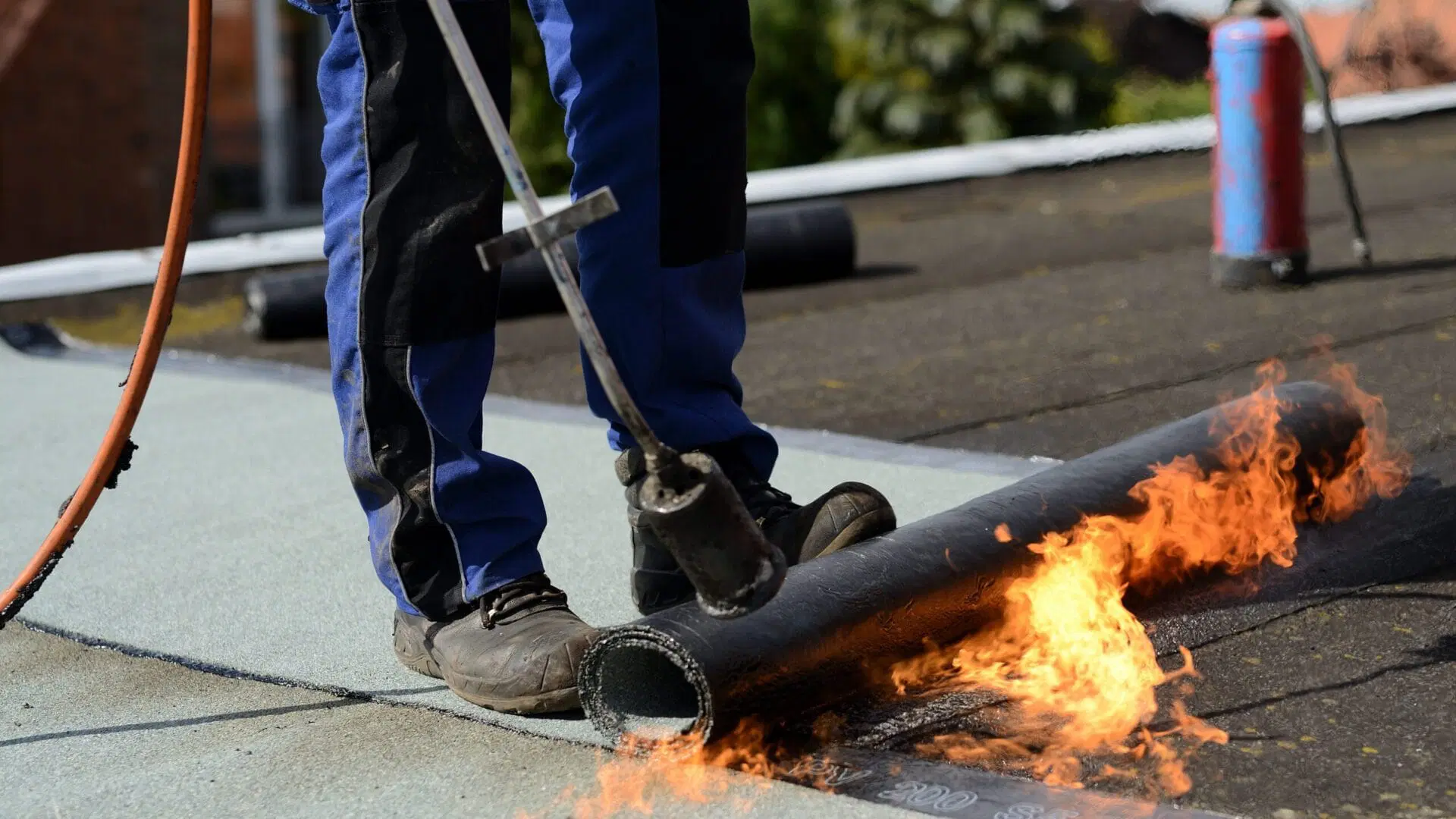
Modified bitumen roofing is a multi-ply asphalt-based system reinforced with polyester or fiberglass mat and modified with either SBS (styrene-butadiene-styrene) or APP (atactic polypropylene) polymers that improve the material's flexibility, elongation, and temperature resistance compared to traditional built-up roofing. Introduced as an improvement over BUR in the 1970s and widely adopted in the 1980s and 1990s, modified bitumen systems are present on a large share of Indianapolis commercial buildings constructed or re-roofed during that period. Many of those systems are now at or approaching end of life, making modified bitumen replacement, recover, and repair one of the most common commercial roofing scopes on Central Indiana buildings today.
SBS-modified bitumen — the more common type in Indianapolis commercial construction — uses a rubber-like polymer modification that improves low-temperature flexibility. SBS membrane is applied by torch, cold adhesive, or heat-welded method. Its superior elongation at cold temperatures makes it well-suited to Indiana's freeze-thaw climate. APP-modified bitumen uses a plastic polymer modification that is stiffer at cold temperatures but more resistant to high-temperature UV degradation. APP is typically torch-applied and was used more heavily in warmer-climate markets, though it appears on some Indianapolis buildings. Identifying which system is on a building matters for repair compatibility — APP and SBS membranes use different adhesives, and cross-system repairs that use incompatible materials fail rapidly.
Modified bitumen systems on Indianapolis commercial buildings show characteristic failure patterns after 20–30 years of service. Lap seam delamination is the most common field failure — the interply adhesive that bonds the modified bitumen plies together loses adhesion over time, allowing seams to open and admit water. Surface granule loss from the cap sheet leaves the underlying bitumen exposed to direct UV degradation, which hardens and cracks the material over subsequent seasons. Flashings at parapet walls, curbs, and penetrations are typically the first area to fail because the flashing membrane on older modified bitumen systems was often applied with less overlap than current standards require. Ponding water at drains and low points accelerates all of these failures by maintaining prolonged moisture contact with seams and flashings that were designed to shed water, not hold it.
Modified bitumen systems are candidates for three different scopes depending on the condition of the existing assembly. Targeted repair — seam resealing, flashing replacement, granule surfacing on exposed sections — extends the service life of a system that has isolated failures but retains adequate adhesion and substrate condition in the field. Recover — installing a new membrane system over the existing modified bitumen with minimal disturbance — is appropriate when the existing insulation is largely dry (confirmed by infrared scan and core samples), the existing system has adequate adhesion, and the building can accommodate the additional dead load of the new assembly. Full tear-off and replacement is required when moisture saturation is widespread, the existing system has lost adhesion across the field, or the building owner requires a new manufacturer warranty with the performance and documentation standards that a recover over an aged system cannot provide.
Modified bitumen installation in Indianapolis requires attention to ambient temperature conditions. Torch-applied SBS membrane — the most common installation method — requires temperatures above approximately 40°F for the adhesive to flow and bond properly. Cold-weather torch applications that are rushed to meet schedule in late fall or early spring can produce insufficient adhesion that fails within the first few freeze-thaw cycles. Cold-adhesive application has a narrower temperature window than torch application for this reason. Indianapolis contractors familiar with Central Indiana's variable spring and fall temperatures build cold-weather application provisions into their modified bitumen specifications rather than assuming work can proceed at any temperature. Scheduling modified bitumen work for the late spring through early fall installation window in Marion County produces the most consistent adhesion results.
When an Indianapolis commercial building's modified bitumen system qualifies for recover rather than full tear-off, the most common recover specification installs a new single-ply membrane — typically TPO or EPDM — over the existing modified bitumen with a recover board between the systems. The recover board provides a clean, flat substrate for the new membrane, improves R-value, and separates the existing and new systems so that any remaining adhesion issues in the old system do not telegraph through to the new membrane. All flashings are removed and rebuilt during the recover to new standards. The result is a fully warranted new roofing system without the cost and disruption of removing the existing assembly — typically 20–35% less expensive than full tear-off on a building with serviceable existing insulation.
Every modified bitumen project — repair, recover, or replacement — begins with a condition assessment that identifies the existing system type, plies, adhesion condition, moisture saturation level (via infrared scan and cores if applicable), and drainage condition. The written scope for any scope beyond minor repair identifies the correct repair or replacement path with supporting rationale. For full replacement or recover projects, the scope includes material specifications, application method, insulation treatment, and a penetration schedule. Upon project completion, the owner receives manufacturer warranty documentation, as-built photographs, a maintenance schedule, and the condition assessment report as a baseline document for future capital planning.
Tell us about the building and the roof problem. We'll document it and put a plan in writing — with an honest repair-vs-replace recommendation and no upsell pressure.
Get a Roof Assessment →