Commercial roofing for warehouses, distribution centers, and industrial facilities throughout Indianapolis, IN. TPO, EPDM, and metal roof systems.
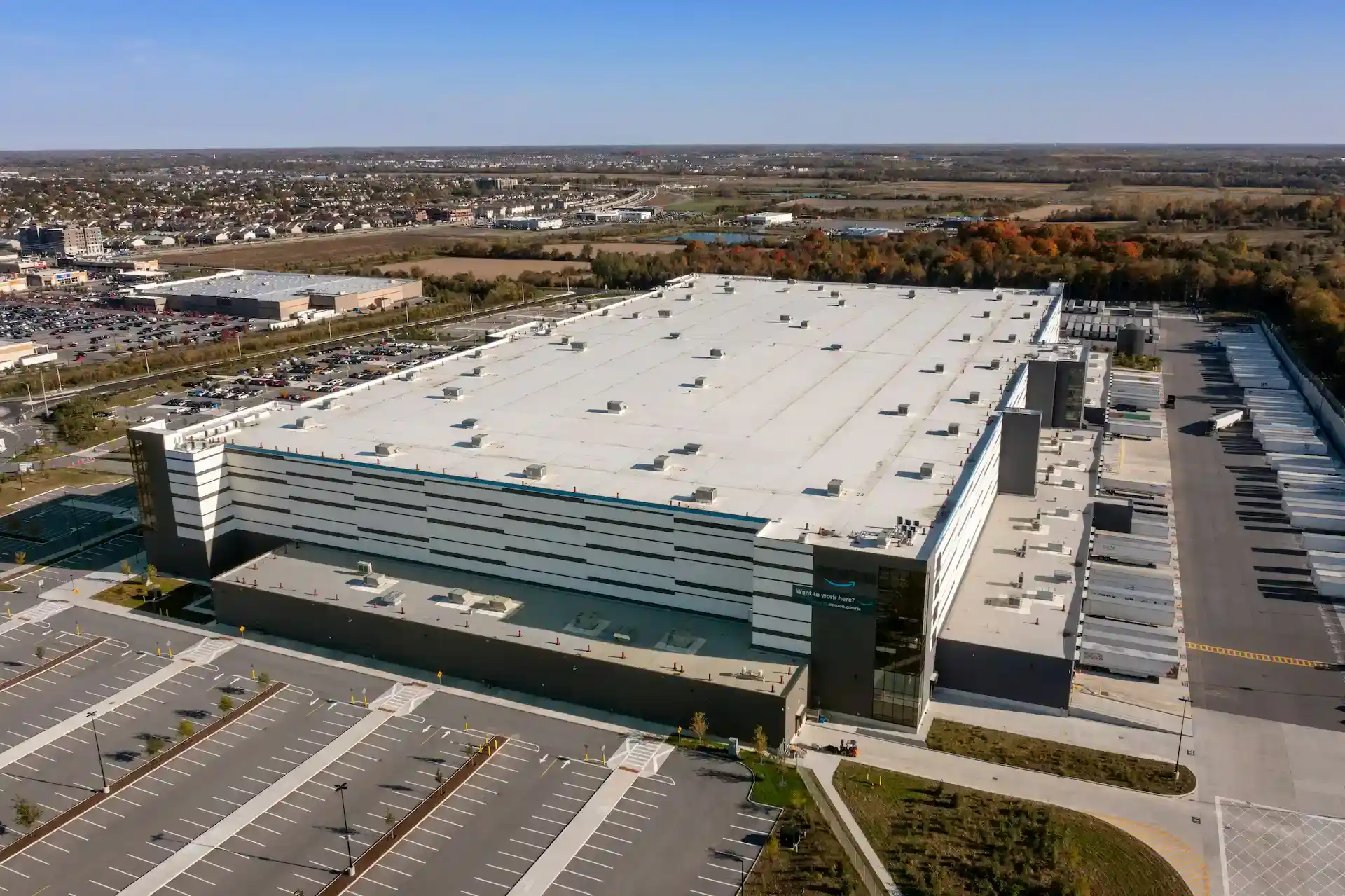
Indianapolis is one of the Midwest's most significant logistics and distribution hubs, with millions of square feet of warehouse and distribution center space concentrated along the I-465 corridor and in the industrial areas surrounding the city. The roofs over those facilities represent a direct vulnerability: a single leak over an active storage rack or conveyor system creates inventory damage, safety hazards, and operational shutdowns that far exceed the cost of the repair itself. Commercial Roofers Indianapolis provides inspection, repair, maintenance, and replacement services for warehouse and distribution center roofing across Marion County and the greater Indianapolis metro, with scheduling and access protocols designed for occupied, operational facilities.
Indianapolis warehouse and distribution center buildings present roofing conditions that amplify the stakes of deferred maintenance. Large, uninterrupted flat roof fields — often 100,000 to 500,000 square feet on a single building — mean that ponding water affects enormous areas when drains are inadequate or blocked. The interior load-bearing requirements of racking systems and conveyor equipment mean that roof deck structural issues, if undetected, can compound into significant problems. Building heights that require lifts and specialized access equipment for roof work, and continuous 24/7 operations that limit when crews can work without disrupting the facility, create scheduling constraints that require experienced project coordination.
Central Indiana's climate is demanding for warehouse flat roofs. Spring rain events regularly dump two to four inches in 24 hours, testing drain capacity on large roof fields where even minor blockage causes ponding across thousands of square feet. Winter snow accumulation on the large horizontal surfaces of Indianapolis warehouse buildings can reach the design load threshold of 25 pounds per square foot during significant events. Summer heat loading on dark membrane surfaces — common on older built-up roofing systems — accelerates blister formation and membrane fatigue. Hailstorms, which occur multiple times per decade with golf-ball or larger hail in Marion County, can compromise membrane integrity across large areas in a single event.
The dominant roofing systems on Indianapolis warehouse and distribution center buildings are TPO, EPDM, and metal panel roofing on the older building stock. Modern distribution centers built after 2005 typically have 60-mil or 80-mil TPO with mechanically attached or fully adhered installation and polyiso insulation assemblies meeting current Indiana energy code. Older buildings may have EPDM systems from the 1990s, built-up roofing from the 1970s and 1980s, or R-panel metal roofing. Each system type has a specific set of repair, recover, and replacement pathways, and the appropriate approach depends on the system age, insulation moisture condition, and the owner's capital planning horizon.
The standard practice for Indianapolis warehouse roofing projects is daily close-in: no open deck areas are left exposed overnight or during shift changes. This requires sequencing the tear-off and installation work so that each zone opened in the morning is fully closed — membrane installed and water-shedding — before the crew demobilizes at the end of the shift. For 24/7 operations, noise and vibration windows are coordinated with facility management to avoid conflicts with order processing peaks. Crane and material staging is positioned to avoid blocking loading dock access, and debris containment prevents wind-borne waste from affecting adjacent operations or inventory.
Ponding water on warehouse flat roofs in Indianapolis is both a membrane degradation issue and a structural loading issue. Interior drains on large roof fields accumulate debris — insulation scraps, wind-blown material, bird nesting — that restricts flow even when the drain body and leader pipe are in good condition. Semi-annual drain cleaning is the single highest-return maintenance activity for Indianapolis warehouse roofs. Where drain capacity is genuinely inadequate for Indianapolis storm intensities, emergency overflow scuppers and additional drain bodies can be added during a recovery or replacement project to bring the drainage design up to current standards.
Tell us about the building and the roof problem. We'll document it and put a plan in writing — with an honest repair-vs-replace recommendation and no upsell pressure.
Get a Roof Assessment →